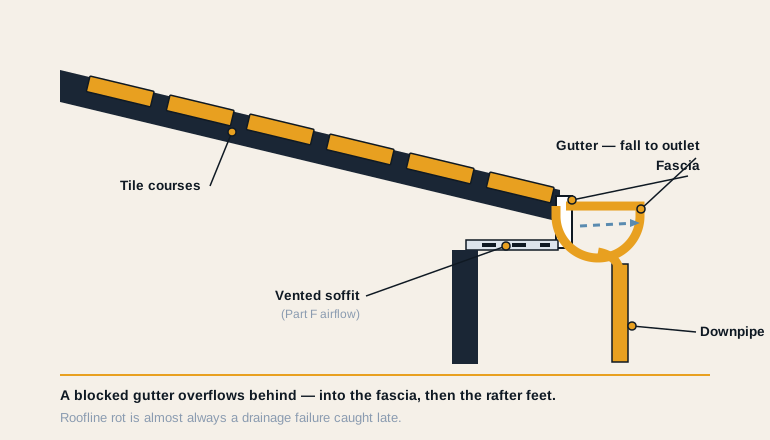
What Happens When Fascias and Soffits Fail
Fascia and soffit failure is a cascade problem — each failure triggers the next, and the cost accelerates at each stage. Understanding the cascade helps you see why early intervention saves serious money.
Stage 1 — Paint failure: The paint coating on softwood fascias breaks down under UV exposure and the Wey Valley's humidity. Bare timber is exposed to moisture. Cost to repaint at this stage: £300–£600 for a typical semi. Most homeowners miss or defer this stage.
Stage 2 — Surface rot: Unprotected timber absorbs moisture. The surface softens and darkens. Fungal growth begins. The fascia is still structurally sound but deteriorating. Cost to replace at this stage: £1,500–£3,000 (full roofline in uPVC).
Stage 3 — Structural rot: Rot penetrates through the fascia board. Gutter fixings lose their grip. Gutters sag and overflow. Water from overflowing gutters saturates the wall below and the rafter ends behind the fascia. Cost now includes rafter end repairs: £2,500–£5,000.
Stage 4 — Rafter damage: Rot has reached the rafter ends. The roof edge is structurally compromised. Tiles may slip or sag at the eaves. Full structural repair plus roofline replacement: £4,000–£8,000+. What started as a £300 repainting job has become an £8,000 structural project.
Capping — The Honest Assessment
Capping — fitting uPVC boards over existing timber — is a legitimate technique when the underlying timber is structurally sound. It saves 35–45% compared to full replacement and provides a maintenance-free exterior surface. However, capping over rotten timber is the roofing industry's equivalent of painting over damp — it hides the problem, traps moisture, and accelerates the deterioration underneath.
We test every accessible section of timber before recommending capping. If the screwdriver test (pushing a screwdriver blade into the wood — it should resist firmly) reveals soft or spongy timber anywhere, capping is not appropriate and we recommend full replacement. This honest assessment is the difference between a solution and a concealment. Some contractors will cap over anything to offer a lower price — the customer saves 40% now and pays 200% more when the hidden rot destroys the rafter ends within 3–5 years.
Soffit Ventilation — The Detail Most Contractors Miss
Building Regulations require continuous soffit ventilation equivalent to a 10mm gap along the full length of the eaves. This ventilation prevents condensation in the roof space by allowing cold air to enter at the eaves and exit through the ridge, creating a natural airflow that carries moisture vapour out of the building.
When soffits are replaced, the ventilation detail must be maintained or improved. We use continuous ventilation strips or circular disc vents at calculated intervals to meet the regulatory requirement. Many replacement soffits we encounter on Godalming properties have been fitted with no ventilation at all — either because the installer was unaware of the requirement or because they took a shortcut. The consequence is loft condensation, which damages insulation, causes timber rot from above, and creates the damp conditions that lead to mould growth. Correcting inadequate soffit ventilation during a roofline replacement costs nothing extra — it is simply a matter of specifying vented boards. Call 01483 346 855 for a free roofline assessment.